Can AI Replace Human Creativity? The Truth About AI Limitations


I've been using AI-tools for years now, long before the AI-craze began.
As someone who has ADHD, I have to make sure that tasks don't feel overbearing since projects will often lead to burnout or I will get too stressed to finish them, even if they are a passion or special interest of mine.
It wasn't until I thought about starting this blog when I realised just how many AI tools I've used over the years. Things like spelling and grammar checkers, social media curation and posting apps, tools to help create and edit music, software to edit photos and much more.
When the latest AI craze began, I generally had very mixed feelings. Dall-E had just become mainstream, and not a day went by that I wasn't having conversations with people about the ethics of generative AI.
At the time, I was streaming on Twitch and would often speak about how I feel like generative AI is a gray area, not only legally but also morally.
Understanding that generative AI models have to be trained on some form of content, I regularly stated that I believed that training content had to be obtained legally; however, I also addressed the topic of "fair use" and how realistically we've historically always been in a bit of a gray area when it comes to art.
I'm sure many of you have heard the argument about how generative AI is similar to Andy Warhol's Marilyn paintings, or music cover artists with the main difference being that it's a machine versus a human. Another core element to add is that generative AI would open up another layer of dishonesty regarding the sourcing of the content.
Disclosure has always been a problem when it comes to creativity. Over the years we've seen a rise of creators stealing works from others, not crediting the source or not "transforming" a piece enough to be classified as fair use. Creatives were already having to discuss what was should be permissible both legally and morally.
Even when I was a teenager I would get into heated debates with other musicians about whether cover artists should pay all of their royalties to the original composer and whether covers should be classified as fair-use. (Just to disclose, I am pro-cover artists and absolutely hate that systems like Content ID regularly destroy the changes of a creator's success.)
So, to me the introduction of generative AI didn't really rattle me as much as it rattled those around me. Quite frankly, I was really interested with how generative AI could help expand a person's creativity rather than being source of a final product.
My Experience Using Non-Generative AI Tools for Creation
I want to start off by talking about my history using non-generative AI tools in my creative endeavours. For clarity's sake, non-generative AI will be classified as tools that do not directly create and are primarily used for editing, or require a significant amount of human input to function.
To be candid, I have used non-generative AI Tools for creation since I began my career. Of course there are projects I have worked on that do not use any of these tools, but I mention this since my career began in 2003, so you may not have expected AI tools to have been around.
MUSIC
Early in my career I didn't own a midi keyboard and would compose in music notation software like Finale Notepad or Musescore. Unfortunately the output always sounded robotic, so I began to use tools to help me humanise the velocity and timing of instruments. Though it never sounded fully realistic, it was the best way I could simulate instruments for Orchestral pieces.
An example of me utilising this process is my song Mousehunt, which was written for a stage production that had a limited budget. As we were unable to hire a live orchestra, I used midi instruments and used AI tools to help humanise them, though every time I think of this song I want to see if I can make it sound more realistic given how much midi and synthetic instruments have evolved; not to mention how much better I've gotten at music production.
While humanisation tools have improved, they aren't a one-click solution. At the moment, I primarily compose piano instrumentals and while the majority of these compositions are one-take recordings of me playing live piano, some have been written in music notation programs.
My reasoning for returning to music notation rather than live recording is fairly simple: I've gotten too stuck in utilising the same chord progressions and structures, essentially making me bored of composition. The reality is, I'm not "tapped out" when it comes to coming up with new ideas, it's more that my hands have build so much muscle memory for one style and until I break myself out of those habits the quickest solution is to manually input melodies into software.
I've also been messing around with an AI tool called Scaler 3 that suggests chord structures and progressions or can quickly change the way chords are played so you can hear it in different styles, which has helped inspired me to imagine songs differently. Alternatively, I've tried tools like Chord Potion and MIDI Wizard that are more randomised and while I've never created a full piece with any of these programs, they have been extremely useful for inspiring me to compose new pieces.
I mention these three programs as they are very well known and reputable, however, in my experience there's a lot of human input required to create a unique piece.
Predecessors of said programs have existed in their own right. For example, early free-ware I used had chord builders and arpeggiators which would only need the user to press one note and the software would build the chord around that. Hell, I just remembered even old $50 Casio Keyboards had this function in the 90s and I'm sure professional synthesizers had even more capabilities.
Two clear examples of arpeggiators are my songs "Artificial Synthesis" and "Perdition" which were part of a concept soundtrack "Basically Average: Adventure Mode".
The concept was to create 9 instrumental pieces that contained the same melodic theme, but depicted clearly formed worlds for a video game.
Artificial Synthesis has 5 layers of instruments being the melody, 2 counter melodies, drums and one arpeggiator.
"Perdition" only the other hand only utilises an arpeggiator meaning I only played the melody of my song and the arpeggiator filled in all of the gaps. While nowhere near being the song I'm most proud of, it was an interesting exploration in how much or little effort you could make to create a sound design for the "fire" elemental world.
Alright enough about apreggiators!! Onto the next tool I've been known to use.
Melodyne is pretty much an industry standard and is often referred to as AutoTune, however, not only can it correct pitch or "autotune", but users can correct timing, add new notes to harmonise or even remove notes/sounds.
I don't really use Melodyne for pitch correction, since I tend to prefer my vocals to sound more natural; but when we ran out of time on my first album my producer and I debated using Melodyne to simulate a 5 part harmony on one of my songs.
Essentially we wanted to use Melodyne to duplicate my voice and treat it as a Vocoder. The best example of a vocoder is Imogen Heap's "Hide and Seek" which was later sampled by Jason Derülo on his song "Whatcha Say". This song was created by Imogen singing one note while playing a keyboard that replicated her voice based on the notes she pressed.
My primary use for Melodyne is to quickly detect notes so I can easily transcribe my music. Unfortunately there's a 5 year gap of files I no longer have due to a bricked hard drive and since a majority of my piano compositions are improvisations... I genuinely don't remember how to play them anymore. Of course I can listen to them and learn to play them by ear, but as I mentioned earlier, I prefer to work smarter not harder.
Since moving countries I haven't collaborated with other producers or artists and for me it's extremely apparent in my recordings. Since all of my music production skills come from being self-taught or watching producers I've worked with work, I lack a number of skills. While most people may not notice it, I lack the ability to do final touches on my song, often referred to as Mastering.
The simplest way of describing Mastering is the act of editing the final mix of a song and making sure it sounds full. This doesn't simply mean adding volume, but it means tampering with the sound in a way that certain resonances are drawn out so the listener feels like they are right there in the studio.
Though my brother-in-law is a producer who Masters music, he hasn't had the time to run me through his process, so I ended up trying LANDR AI Mastering. Quite frankly, it was so good. I would say it would perfect my songs' sounds to be 85% perfect, and the remaining amount would just require me to automate some portions since my music tends to have a lot of dynamics.
Only issue: a few of my songs got dinged as "AI-Generated" on Deezer. Now, this isn't to spark an alarm stating that artists who uses AI mastering tools always will be dinged especially because it's been standard for indie artists to use AI Mastering tools through their distributors for about 5 years now.
Though I personally pulled the songs that were dinged down and re-edited them manually, I'm curious to test out what caused the incorrect disclaimer as I'm certain there are certain settings in the software that create too many artefacts causing the detector to flag the song.
Finally, since all my music is predominantly recorded through a digital keyboard I feel like it's a requirement to state that this is a form of AI. I know, I know, it's silly that I even state that or classify it as AI, but given the fact that I was raised on non-pressure keyboards that had a single velocity for every note, I must appreciate how much digital keyboards have improved. The fact that I no longer need to rent out studio space and have been able to convert a room in my house into a studio is remarkable. Thank you technology.
If you're a musician who's interested in composition and production, I've started a new blog called Never Too Late Music where I'll go into detail about the capabilities of software and what I like to use them for.
As for my conclusion on this section: While there's a vast number of tools in the music composition and editing field, none of them have replaced my need to interact with the pieces. Whether it's in composition or post production, there's a great deal of creativity and human touch that is required.
PHOTOGRAPHY
I post on Instagram sometimes, does that make me a photographer? No, but my sister was a professional photographer for years and I was always blown away with the editing she could do in Photoshop.
Though I never became a master of Photoshop, I have been using a software called Luminar for years. When I first started using Luminar it only had the ability to apply filters and colour correct images. For me, this was all I really needed it for.
Since I'm not the best photographer and don't actually understand lighting or cameras, I would always use Luminar to edit photos for my blog Pets Overload. In more recent versions of Luminar, specifically Luminar Neo, users have a shocking amount of AI tools at their fingertips that make the process even easier.
Quite frankly, every single photo I ever upload to the internet goes through Luminar, even the screenshots of video games for my blog Basically Average.
Luminar is basically the "big boy" version of FaceTune, still allowing users to manually colour correct and fix images, but also providing one click AI features.
I'll do a long deep-dive of Luminar Neo in the future, since I absolutely love it, but some of the key AI features include removing image noise, image sharpening, changing out backgrounds, changing lighting, removing blemishes, adding Bokeh, and altering physical features (such as making faces skinnier and such.)
While I personally limit my use to colour correction, I have played around with the replacement functions and quite frankly they are impressive. Hell, even though Facetune is a mobile app it's extremely impressive.
Now, would I say that the photos I take and edit are better than my sister's? Absolutely not. Though Luminar Neo has significantly improved my photography, it will always lack the creativity and uniqueness that skilled photo editors and photographers have.
While yes, with each update the capabilities become more powerful, the idea that good photo editing can be done in one click is not probable. Heck, even the more basic functions like exposure or colour correction end up making a photo worse since the AI doesn't actually know what you want and is basing the corrections on an algorithm.
There are sliders for each AI function that allow you to play around with different settings, but at that point I have to say that it's not a case where "AI will simply take over the photo editing" and will instead help streamline certain projects.
My conclusion to this section is simply that in my experience, AI Photo editors have helped make my non-professional photos look a lot better, but if I need a good album cover or a great head shot, I'll always head to a photographer.
WRITING
I'm not really going to go into this topic in depth as I recently did a deep dive on Grammarly, but my TLDR is that non-generative writing tools aren't perfect and while they're great for making sure that content has good punctuation, they often result in dehumanising text.
I'll let you read that deep dive though.
My Experience Using Generative AI Tools for Creation
I'm obviously not ashamed to admit that I have dabbled quite a bit in the field of generative AI.
Quite frankly, when I first bought the domain for this site it was as an archive for memes my Twitch community and I created. I had purchased a copy of WordHero in hopes of using it for blogging tasks I was struggling with like SEO descriptions and to help outline posts.
I never outline my posts before I write them and freely write, so I'd often get into situations where my blog posts had nothing to do with the topic in the title. Though, I'm sure you've noticed that by now.
At the time, WordHero was very new and wasn't as useful as I hoped, so instead my Twitch viewers would redeem for WordHero to write a poem or a song and we'd post it here with an image that was generated from the text using Dream by Wombo.
During that time I also began dabbling in other generative AI, both so I understood where AI was going and to hopefully stumble on tools that would help lessen or streamline my workload. And lookie now... here we are!
MUSIC
I've actually played with a great deal of generative AI when it comes to music, especially when people were fuming about Suno and how it was going to replace real musicians.
At the moment the software I have the most experience with has been Suno and AIVA, though I've dabbled a bit with competitors to see what they can do and am hoping to go into great depth as I continue to post on this blog.
Admittedly, I'm very impressed with how capable AI has been in regards to music generation, but as someone who composes for a living I'm genuinely not worried that it's going to take my job.
I'll save the specifics for reviews and deep dive explorations, but my general analysis when it comes to generative music is that it lacks a lot of quality and soul. Now, this doesn't mean that AI music isn't "good" or that people will suffer when they listen to it, but it does mean that at the moment everything is coming out sounding the same.
My biggest problem with generative AI music and the thing I think it lacks the most is audio clarity. For example, I subscribed to Suno for a full year, experiencing it from 2.5-4.5 to see how it would develop. While I was impressed with how much it advanced in that year span, I can't say that there was anything I generated that I was jealous of or wish I had written.
While yes, some of the melodies that I generated from all software have been extremely interesting and helped me analyse my own musical composition differently, the sheer fact that audio quality and musical nuance lacks was a massive turn off.
I also tried having these software cover my music, some versions were extremely creative while other versions were just... no. No matter what software I used, they were all a crap-shoot. Which is a prevalent issue when it comes to all generative AI in my experience.
I'll say, for those who do not compose, edit or play music; music generation AI is going to be world changing, but if you're someone who's an audiophile or enjoys nuance in music, I'm uncertain AI is going to overtake. AI isn't creative, AI doesn't have new thoughts, AI doesn't fully understand why certain things work and don't work.
So while AI can create a song that has a beginning middle and an end, I don't think it will be able to create a masterpiece that is as emotive as a human can.
Even with my more emotive piano music that has lots of dynamic changes and tempo changes, the covers would come out more rigid and stinted. I'm actually still hoping that AI advances fast enough for me to be able to upload an instrumental that it can sample and convert into other instruments, since sometimes I can't find the right sound I need, but that time hasn't come yet.
So from both a creative and technical standpoint, I don't feel like AI is at a point where it's going to steal musicians' jobs.
While yes, I do understand that AI generated music has the potential to fill up the market space and I have experienced a loss of revenue from AI content creators spamming and botting on streaming platforms, I don't think it will directly replace me.
For more transparency, since the introduction of AI music generators my listeners and sales have not declined and continue to grow steadily, however, since many streaming platforms do not pay by the listen but by a percentage of a huge pot, many artists have seen a loss of income.
With that being said, I think that given the more generic nature of AI music the chance of nostalgia or revisiting the music years later because you absolutely loved it is not very probable. Unless a song is particularly memey or holds very specific sentimental value, I think in the long-run human made music will still outweigh AI.
I do think we're always going to have an influx of slop and that it will become increasingly harder to make money as a creative; however, I do see those who are genuinely creative using tools like this to significantly advance their own music especially if audio quality improves.
If AI gets to a point where it can create extremely clear audio, I think those who are creative will use AI generative tools to enhance their music, but I think it will always need a person refining and perfecting it for it to become a masterpiece.
DIGITAL MEDIA (IMAGE & VIDEO)
I would not consider myself a digital artist by any means. While yes, I've drawn and animated Twitch emotes, I can't pretend that they are "god-tier."
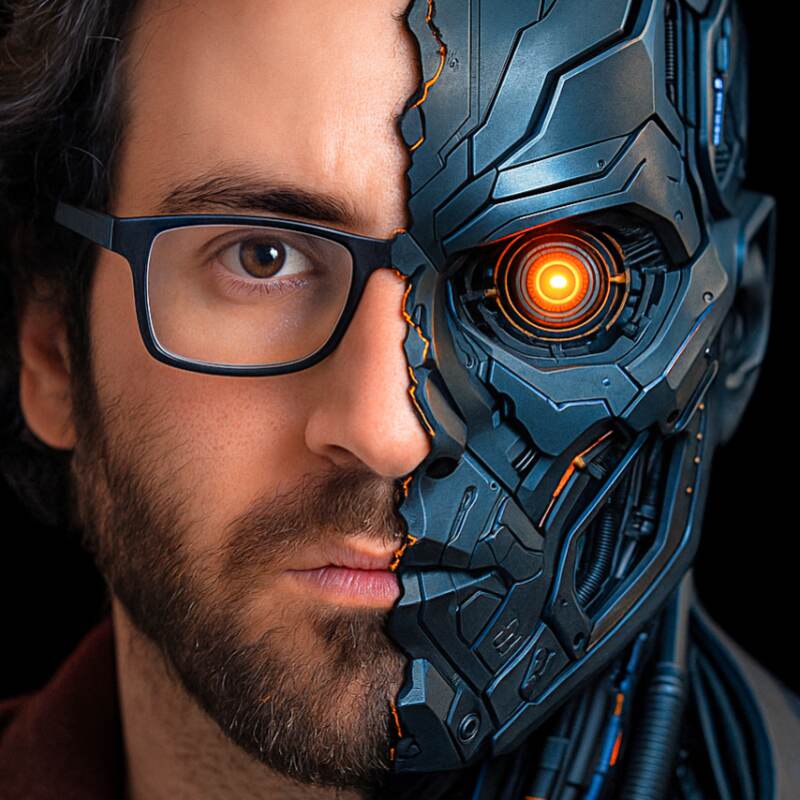
I have used a lot of generated images for multiple purposes over the years and will often draw a sketch and then ask an AI to enhance and build on it. The most obvious example of that is the featured image on this post.
As I would consider myself to be a layman of visual art, I would say that digital generated media appears as "acceptable." Much like generative music, I can see that there are flaws, I know that there are problems, but since it is not my profession or passion I can easily say "I don't care that it's not perfect." Though, with that being said, the image above took me 15 generations in multiple generative AI tools until I generated one I was "happy with." Still, I edited it in Luminar and was about to open Photoshop to edit it further before I stopped myself and asked "but why?"
Much like music generation, AI Digital Media is such a crapshoot. A number of software I have include monthly tokens for it and I always try to use them all to figure out what weird things I can come up with.
I have a lot more experience playing around with AI images than I do with videos, especially because I use AI images for playlist covers when I don't have an appropriate image available to me.
In regards to video, currently the only experience I have is using the free tokens Bing gives you for Sora and I have to say, I'm really not impressed and often just generate a plethora of cursed content.
Now, I am a relatively big consumer of AI generated video media. I watch a lot of YouTubers who create masterpieces using generated video media, but even their media is... well, imperfect.
Though I think generated media is getting better, and better, with what little experience I have from generated digital media: it's going to take a lot of money and a lot of prompting.
There are so many people who are worried that AI is going to take over the film industry, but again, I don't think it's realistically going to happen. Similarly people are complaining it's going to take over the digital art space, and I also think we're not going to get there.
What I've noticed in particular with generated visual art is that images start looking extremely similar, you will prompt multiple times with different keywords, requesting specifically that things look different... but they won't always go the right way. In fact, the more you prompt, the worse things will often get.
I think a huge part of the AI generation phenomenon is that when people try their first prompt they're blown away by the capabilities, but as soon as they start asking for refinement they see how AI isn't actually capable of refining or creating the thing you specifically want.
In many cases, this is going to be fine for the average user, since not everyone is going to have a very clear image of what they want or will not be a perfectionist, but much like music, the things that will stick will be the things that had the biggest emotional impact. So, if the generated AI is extremely funny or you were able to pull on someone's heartstrings, it will be remembered; but chances are it's not because of how impeccable the artistic direction was.
Still, this is the field I want to explore the most when it comes to AI creation. As someone who used to be in film production and used to work professionally as a playwright, I want to see if there's an affordable way to create visual media for projects I had to shelf due to funding restraints.
WRITING
Arguably the only generative content I'm actually worried about is writing; however, it's not from the perspective of creativity. Though, with the state of the Netflix era where TV and Movies just feel more and more poopy... maybe.
Realistically, I have the biggest problem with text based generative AI as I watched my industry crumble as it happened. Admittedly, the blogging industry not only crumbled because of AI content creation, but because of the way that search engines dealt with it and the fact that search engines now have their own AI that gives you answers without you actually going to the websites it's pulling content from.
Now, my gripe is fairly personal. Before I committed to being a full-time recording artist my sole income was from blogging and my content was all technical, meaning the people who ended up reading my content were looking for specific answers. This meant that even if I would be the first search result, the whole answer to your question was answered to you by the spotlight and I wasn't paid for it.
Alright, complaint over.
When I debated returning to blogging after being burned by the industry so many times I analysed what my biggest struggles were. As mentioned earlier, drafting was a key issue and to be quite honest... wording things can be very difficult for me.
Though absolutely no AI was used for this piece, since it's more of a thought piece, I have used tools that have helped me draft some of my newer posts. Essentially I will tell the AI what my topic is, tell it to research the topic and then come up with headers/categories I should talk about.
Much like music, I refuse to release anything that was fully generated by AI. While yes, I will use AI tools that assist me into reaching my goals; on a professional level I cannot deny how useful AI has been to talk to about what I want my piece to cover and bounce ideas off of.
I will not deny, I have spent hours talking to AI about concepts for a post, essentially asking it to do research on whether a topic will be interesting enough to readers, or asking it whether a topic should be split into multiple sections; and truthfully this is where I think writing generators excel.
I've had AI tools write full blog posts before and while they are arguably well written, for the most part, they again have no soul. Yes, you can prompt AI to have different voices and styles of writing, but it still feels a bit lacklustre to me, though less apparent than other creative fields.
Writing generators definitely excel at more technical writing, but as soon as you give them a creative prompt it's 100% hit and miss.
When I still had a subscription with Suno and was creating meme music for my friends and I to listen to I used generative AI to help me write lyrics, but still songs would take days to write (albeit, sometimes by the end the lyrics were better than anything I could have thought of.)
I'd say that generative text requires less prompting overall when it comes to fact based pieces (though it can be incorrect since the internet isn't inherently filled with facts), but as art is subjective, I can't imagine AI fully taking over the creative field either.
For one of the meme songs I was the most passionate about working on I ended up prompting the same line to be changed about 40 times, that being one line of a 3 verse, 1 chorus, 1 bridge song. I can't even begin to imagine how many prompts in total I requested.
AI also doesn't understand emotion. I tried having it write short scripts and while there were some lines where it excelled, the majority had me saying... what?
So, overall like all the other generative AI models, it's going to be hit and miss. Though again, more refined in some fields.
SO, CAN AI REPLACE HUMAN CREATIVITY?
I am a firm believer that AI cannot replace human creativity.
I do think that AI is definitely impressive and can create some really great generic pieces in multiple fields, but I don't think that we will be overtaken by AI anytime soon.
Though it's probable that AI will become better and better the more information it gets, the reality is that there are severe limitations when it comes to prompting. If humans struggle to get ideas across when collaborating, it's improbable that an AI model will simply be better at collaboration because it has a wider database.
Pretend that AI models aren't the problem in the equation and that it's actually the way the human is communicating that is causing slop to be created, would that not mean that the majority of humans would not be able to create good generative AI?
If we "hack" the AI and find the exact right prompts to use, will we not just be bored of the content that's created and no longer interact with it? I mean, realistically that's already happening. I'm sure we've all seen the stupid cat videos on Instagram that put animated cats in the weirdest domestic abuse situations; those too will be gone.
All-in-all, the biggest issue with all generative AI is the fact that it must be trained on something in order to provide new content, meaning that AI is being trained on AI. You'll often see that a new model works much better on launch then steadily goes downhill until the next model, but even then it holds some remnant issues from previous models.
AI is much like Ouroboros, the snake eating it's own tail. When it comes to creativity, there will always need to be a human involved to help refine it.
I'm actually excited for the future of AI, but not because I believe it will be a one-click solution for creativity, but because I think it will significantly help streamline tasks. I think these tools can be extremely useful for learning about what you can improve on, or can help you break out of patterns you're stuck in.
Otherwise, I think AI itself will simply regurgitate until it has new human content to feed off of and then rinse and repeat.